
حوّل رؤى الذكاء الاصطناعي إلى أفعال منسّقة

الرائج الآن
Categories
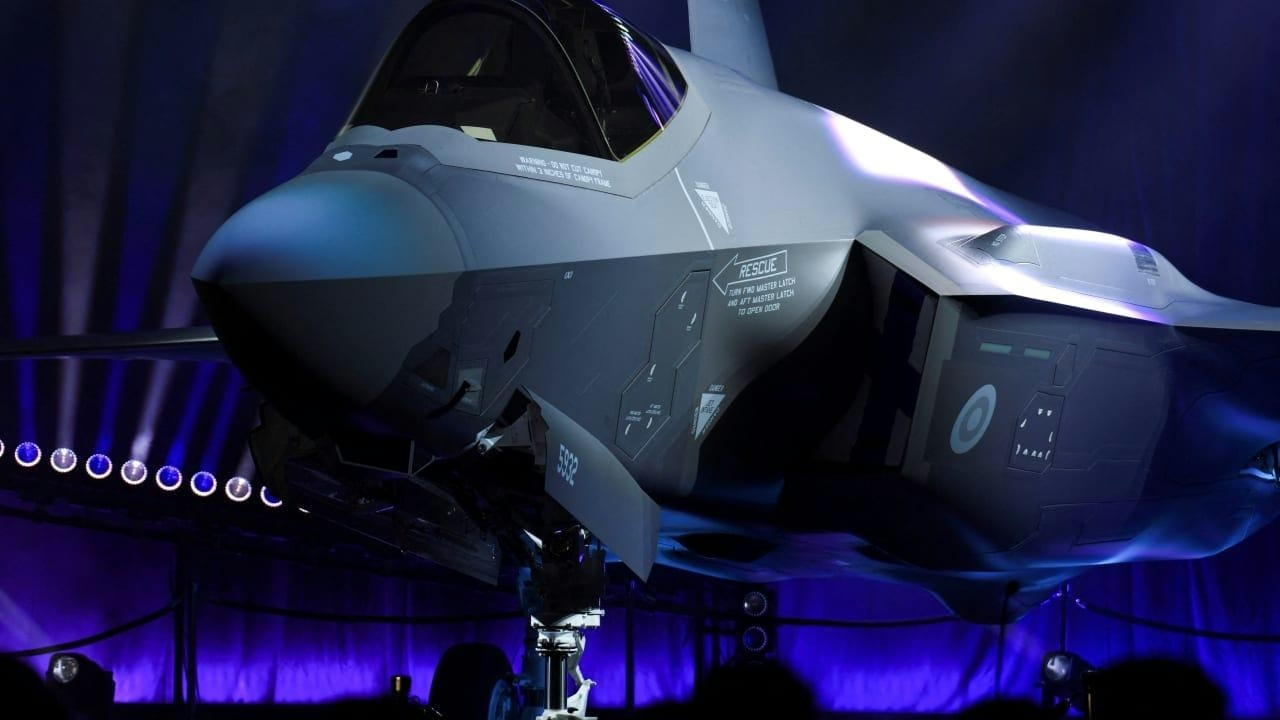
Advanced Fighter Jet Integrates AI for Threat Detection
Advanced Fighter Jet Integrates AI for Threat Detection
Breakthrough in Combat Identification Technology
Lockheed Martin has achieved a significant milestone by successfully flight testing an artificial intelligence-enabled Combat Identification capability on the F-35 Lightning II. Conducted at Nellis Air Force Base, this demonstration marks the first instance in which a tactical AI model independently generated combat identification during flight, enhancing the pilot’s ability to detect and classify hostile radar emissions with greater precision.
The test was part of Project Overwatch, an initiative that integrated a proprietary machine learning model into the F-35’s information fusion system. Unlike conventional heads-up displays, the F-35 delivers flight and threat data directly onto the pilot’s helmet visor and a wide-area cockpit display. During the trial, pilots received identification cues simultaneously from both the legacy system and the new AI model, enabling real-time comparison and validation of threat information.
Addressing Complex Threat Environments
The AI system demonstrated a remarkable capacity to resolve ambiguities among complex radiofrequency emitters, a challenge that has intensified as modern air defense systems frequently modify radar modes, wavelengths, and transmission patterns. Traditional systems often flag unfamiliar signals without providing precise identification, leaving pilots to make critical decisions amid uncertainty.
This challenge was exemplified during NATO patrols following Russia’s invasion of Ukraine, where F-35 pilots encountered S-300 (SA-20) missile systems operating in previously uncataloged modes. While the aircraft detected these emissions, positive identification was only possible after ground teams updated the threat database. Project Overwatch seeks to shorten this cycle by enabling engineers to label new emitters, retrain the AI model within minutes, and reload updated software during the same mission planning window. This rapid reprogramming capability reduces decision latency and significantly enhances situational awareness in contested airspace.
Implications and Industry Response
As air defense environments grow increasingly complex, the integration of AI introduces both opportunities and challenges. Ensuring robust cybersecurity is critical to protect AI systems from adversarial attacks, particularly as threat actors employ AI to accelerate reconnaissance and evade detection. The reliability of AI-driven identification depends heavily on the quality and integrity of training data, raising concerns about potential misuse or skewed outputs.
The defense industry is actively responding to these technological shifts. The ongoing AI supercycle is anticipated to drive a surge in mergers and acquisitions within aerospace and defense sectors, as companies seek to consolidate expertise and maintain competitive advantage. Rival firms are accelerating their own AI integration efforts, focusing on developing trustworthy and secure systems to mitigate risks associated with data manipulation and adversarial threats.
Lockheed Martin’s demonstration represents a pivotal advancement in combat aviation, underscoring both the promise and complexity of deploying AI in high-stakes operational environments. As AI becomes increasingly embedded in defense platforms, the industry faces the dual imperative of harnessing technological advantages while safeguarding against emerging risks.

Etihad Airways Suspends Airbus A380 Flights on Key Route

Aditya Birla Group Seeks Approval for Aircraft Leasing in GIFT City

Qatar Airways Highlights Innovation and Connectivity at Arabian Travel Market 2026

Hong Kong's Five-Year Plan Includes Andrew Fan's Aircraft Parts Processing Hub Proposal

ACIA Aero Leasing Delivers ATR72-600 to Air Nostrum

RTX Appoints Jill Albertelli as Head of Pratt & Whitney

TAT Technologies Joins Beyond Aero Hydrogen Aircraft Program

AURAK Study Highlights Barriers to Air Taxi Adoption in Emerging Economies

Xiamen Air Selects Altitude for 787 Maintenance at Heathrow

Etihad and Swissport Extend Global Partnership
